

Currently Empty: $ 0
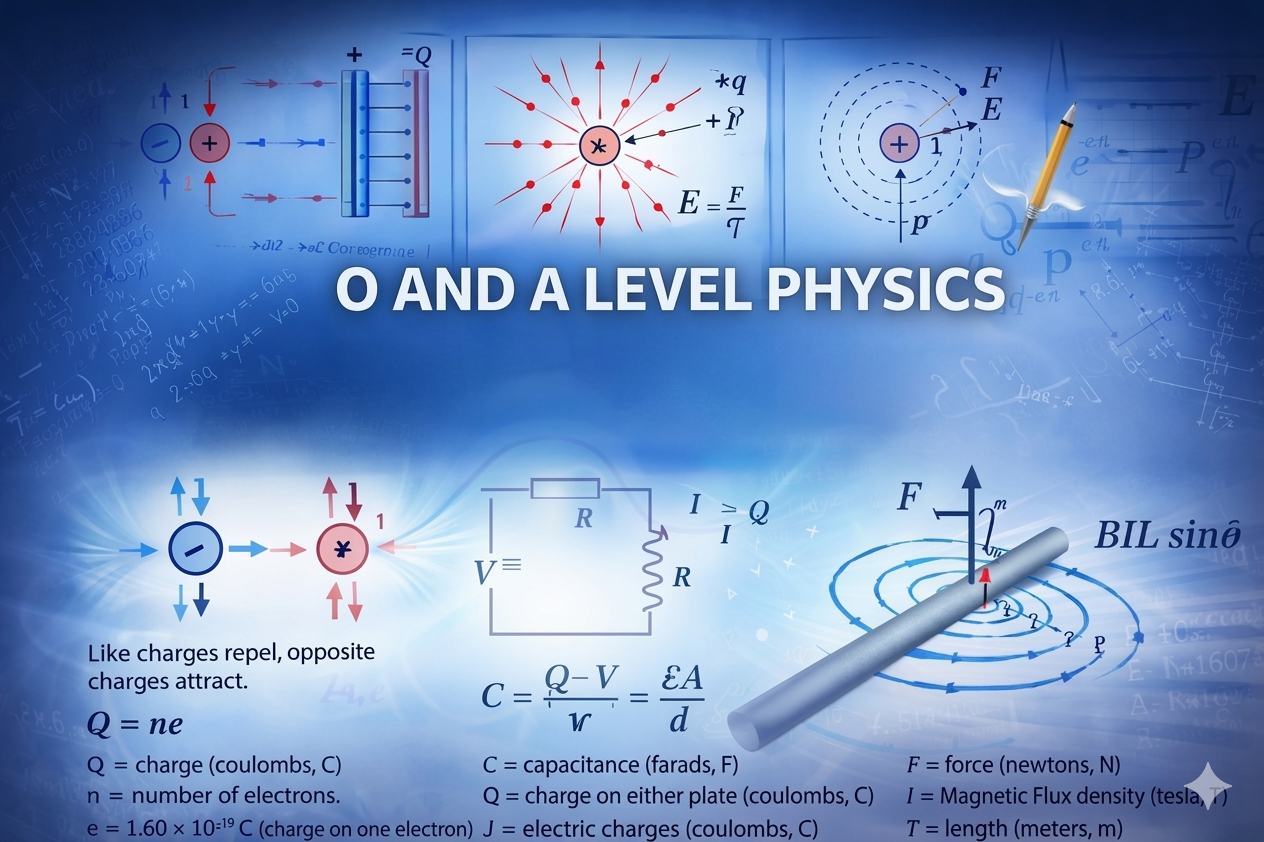
Let’s be honest—IGCSE Physics can feel like juggling equations, graphs, and invisible forces all at once. But the good news? With the right strategy, even the trickiest topics become manageable.
Whether you’re aiming for an A+ or just want to survive paper 4, these pro-level exam tips will help you study efficiently, solve problems with confidence, and walk into your exam like a physics pro.
Why Physics is Important for A/O Level Students
Develops analytical and critical thinking skills through complex problem-solving.
Provides the theoretical foundation for Engineering, Astrophysics, Robotics, and Architecture.
Enhances understanding of modern technology, from smartphones to medical imaging like MRI scans.
Builds mathematical modelling skills, allowing you to predict how physical systems will behave.

Physics O Level (5054) – Syllabus Overview
The O Level curriculum focuses on these 6 core lessons to build a versatile scientific mindset:
- Basic Concepts of Motion, Forces, and Energy: Understanding kinematics, dynamics, and the conservation of energy.
- Properties of Matter: Exploring the kinetic model of solids, liquids, and gases, along with thermal properties.
- Waves, Sound, and Light Principles: Mastering the behaviour of longitudinal and transverse waves, including reflection and refraction.
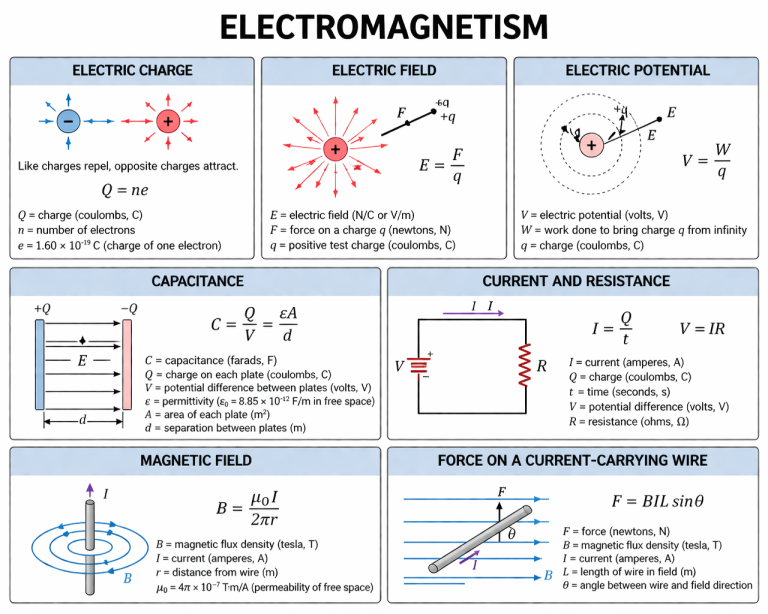
- Electricity, Magnetism, and Electromagnetism: Diving into circuits, magnetic fields, and how we generate electrical power.
- Atomic Physics and Radioactivity: Discovering the structure of the atom and the nature of radioactive decay.
- Practical Applications & Scientific Investigations: Developing the hands-on skills required for experimental design and Paper 4 (ATP).
Physics A Level (9702) – Syllabus Overview
The A Level syllabus takes these concepts into advanced, theoretical territory:
- Advanced Mechanics: Circular motion, oscillations (SHM), and gravitational fields.
- Fields and Particle Physics: Deep dives into electric fields, capacitance, and the standard model of particle physics.
- Medical and Quantum Physics: Exploring photons, the photoelectric effect, and the physics behind ultrasound and X-rays.
Top Resources for A/O Level Physics
- Topical Past Papers: Solving problems by topic helps identify which formulas apply to specific scenarios.
- Simulation Tools: Use interactive PhET simulations to visualise invisible concepts like magnetic fields or wave interference.
- Data Booklets: For A Level, familiarise yourself with the list of constants and formulas provided in the exam.
- Practical Lab Manuals: Reviewing common experimental setups is vital for scoring high in the practical components.
Exam Preparation & Strategy
- Master the Formulas: Don’t just memorise them; understand the relationship between variables (e.g., how doubling the force affects acceleration).
- Units are Crucial: Always double-check your units. A correct numerical answer with the wrong unit (or no unit) will cost you marks.
- Drawing Clear Diagrams: Whether it’s a free-body diagram or a circuit, a neat, labelled sketch can help you clarify your own thinking and earn marks.
- State the Law: When a question asks to “explain,” always start by stating the relevant physical law (e.g., Newton’s Second Law or Lenz’s Law).
Common Mistakes Students Make
- Confusing Mass and Weight: A classic error that leads to wrong calculations in dynamics.
- Vector vs. Scalar: Forgetting that direction matters in quantities like velocity, displacement, and force.
- Significant Figures: Not rounding your final answer to the appropriate number of significant figures as specified in the paper.
Final Words
Physics is a subject that rewards conceptual ownership over rote memorisation. Once you understand the underlying principles, the math falls into place. By approaching the syllabus one module at a time, you can master the complexities of the physical world and secure your A*.